

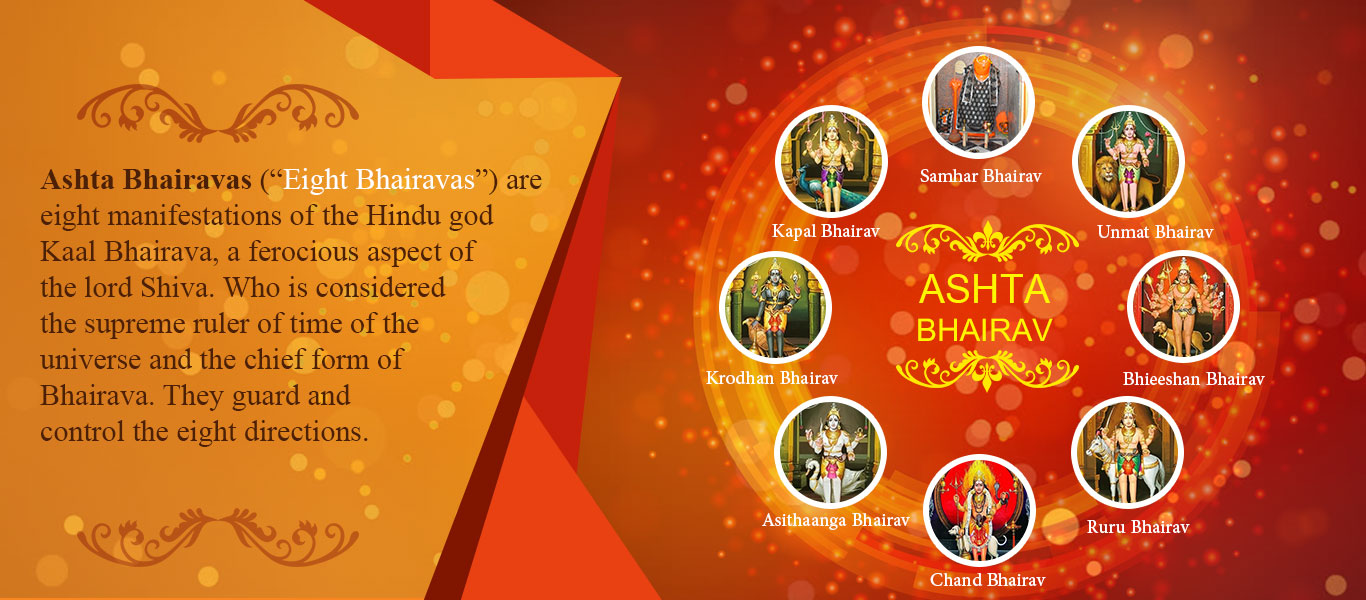
The eight Bhairavs are said to represent five elements viz. sky, air, fire, water and earth and other three being sun, moon and soul. Each of the eight Bhairavs are different in appearance, have different weapons, different vahanas and they bless their devotees with eight types of wealth representing ashta Lakshmis. Continuous worship of Bhairav leads the worshipper to a great Guru. There are separate dhyan slokas and moola mantras to all the eight Bhairavs.
It is generally believed that worshipping Bhairavs gives prosperity, success and good progeny, prevents premature death and solution to debts and liabilities. Different forms of Bhairav evolve only from Shiva, who is called the Bhairav. The name Bhairav itself is replete with deep meaning. The first syllable ‘Bhai’ means fear and also lustrous light. It is said to endow one with material wealth. ‘Rava’ means echo. While ‘Ra’ casts off negativity and restricted consciousness, ‘Va’ keeps creating opportunities. In totality Bhairav denotes that by using fear we can attain ‘aseem anand’ or extreme delight. In Shiva temples, regular puja starts with Surya and ends with Bhairav. The best time for Bhairav worship is the midnight puja on a Friday.
 Bhairav deity is usually situated in north or south facing direction. As a deity, Bhairav appears in a standing position with four hands. His weapons are damaru, pasam noose, trine and skull. Sometimes, Bhairav is shown with more hands. He appears semi or fully naked. He is accompanied by his Vahana, a dog. The dog is not just a means of transport but is a shwan participant in Bhairav’s ferocious activities. Bhairav has protruding teeth and looks terrible. His garland is made of red flowers.
Lord Bhairav is also known as ‘Kotwal’ or ‘Kshetpalaka’, the guardian of the temple. The keys to Shiva and Shakti temples are ceremonially submitted to Bhairav at closing time and received from him at the opening time in the morning.
Benefits and Significance of Ashta Bhairav Maha Homam: The most important and common benefit of performing Ashta Bhairav maha homam is for getting favor from the Lord Maha KalaBhairav “The God of Time” to avoid misfortunes in life.
By undertaking Ashta Bhairav Yatra, one is relieved from all troubles and earns the grace of Sri KalaBhairav. This is a must for Bhairav Upasakas. Even upasakas of Devi i.e. Shaktas undertake this Yatra as Bhairav’s grace is essential in Tantric Upasana. The Eight Forms of Bhairavs are:-

Kala Bhairav is a fierce manifestation of Lord Shiva and is highly revered across the Indian subcontinent. He is depicted in an aggressive form with angry eyes shaped like lotus blossoms, blazing hair, tiger's teeth, and snake coiled around his neck or crown, and an eerie garland of human skulls. Often terrifying, Kala Bhairav carries a trident, a drum and the severed fifth head of Brahma. The deity is blue throated from swallowing poison to save the world. Hence, he is considered to be the vanquisher of death. His third eye represents eternal supreme wisdom. Bhairav manifestation is traced in the Shiva Puran. Lord Shiva takes the form of Kala Bhairav to behead Brahma in a superiority contest between Vishnu and Brahma. Thus, Kala Bhairav embodies the wrathful side of the Lord Shiva. He can be invoked for destroying negative energies and for protecting us as well.
There are many interesting legends surrounding Kala Bhairav, one of the eight avatars of Lord Shiva. The origin of the mighty god is attributed to a tale in the Shiv Mahapurana.
Long time back several great Sages sitting atop Sumeru Mountain desired to know from Lord Brahma as to who was indestructible and supreme. Lord Brahma proclaimed himself to be that superior person. On hearing this, Yagyeshwar (symbolic of Narayan) reprimanded Lord Brahma for his hasty and audacious utterances.
Both of them asked the same question to the four Vedas. Rig Veda replied that the omnipotent deity who controls all living beings, named Rudra is supreme. Yajur Veda replied that He, whom we worship through various Yagnas (Yagam) and other such rigorous rituals, is none other than Shiva, who is supreme. Sam Veda stated that the respected figure who is worshipped by various Yogis and that Person who controls the entire world is none other than Triambakam. Finally, Atharva Veda said, all human beings can see the Lord through Bhakti Marg and such a deity who can remove all the worries of human beings is indeed Shankar. In a nut shell, all the four Vedas proclaimed that Lord Shiva is the ultimate being.
Both Lord Brahma and Yagya Narayan started laughing in disbelief. Shortly Lord Shiva appeared as a powerful divine light in their midst. Lord Brahma stared at that Being furiously with his fifth head. Lord Shiva immediately created one living being and stated that he (the new being) will be King of Kaal and will be known as Kaal Bhairav. (Here Kaal is denoted to final time viz. death). Lord Shiva further stated Kaal Bhairav will always be in Kashi, removing all sins of the devotees and therefore, he will be known as Paap Bhakshak.
Meanwhile, Lord Brahma's fifth head was still burning with fury and Kaal Bhairav plucked that head (just as we pluck flowers from the garden). Immediately all the people present there started singing praises of Lord Shiva. Lord Shiva directed Bhairav to go around various places but Brahma Hatya Dosh (affliction on account of hurting a Brahmin) will always follow him. Lord Shiva created a dangerous and fierce looking female figure, named Brahma Hatya and asked her to follow Kaal Bhairav wherever he went.
Kaal Bhairav, with Brahma's head in his hand, started going around various places in the world, took bath in various Teerths, worshipped various Lords, nevertheless saw that Brahma Hatya was following him all along. He could not get rid of that affliction, that sin.
Finally, Kaal Bhairav reached the Moksha Puri, Kashi. The moment Kaal Bhairav entered Kashi, Brahma Hatya started shouting, screaming and finally disappeared into the netherworld. The head of Brahma, (Kapal) fell at a place which was called Kapal Mochan and there was a Teerth which was later called Kapal Mochan Teerth. Then onwards Kaal Bhairav stationed himself permanently in Kashi, giving shelter to all his devotees. Those living in or visiting Kashi, must worship Kaal Bhairav and he grants protection to all his devotees.
Old timers in Kashi believe whenever residents of Kashi leave the city for short journeys, they worship Kaal Bhairav (taking his permission) and on return back to Kashi, they again worship Kaal Bhairav.
Kaal Bhairav is located at K-32/22, Bhaironath. People can approach this place by rickshaw either through Bisheshwarganj cross roads or through Golghar (Maidagin). This is a very famous temple and devotees will be guided by the local residents.